Showing posts with label WW2. Show all posts

Saturday, 22 April 2017

Battle for Braaga 2 - Engagement

The battle opened with a few shells from West Friesland (off table) medium artillery dropping on the edge of the town. One salvo reduced a damaged building to mostly rubble and a couple dropped into established depressions, turning them into muddy craters as the long range guns sought to set up programmed fire points from advice being passed from the command unit on Fuchsschwarz Hill to the right rear flank of West Friesland lines.
West Friesland battle lines move 1.

The sound of gunfire and explosive detonations covered the sound of tanks and other vehicles revving up as the West Friesland assault commenced.

After an initial soft advance by the West Friesland forces, the central column began to move in earnest on the town whilst overhead, spotter aircraft hummed noisily, overflying the enemy positions.  Whilst already installed East Friesland men held position, the arriving Hessnovinians began to unload men and equipment from vehicles.
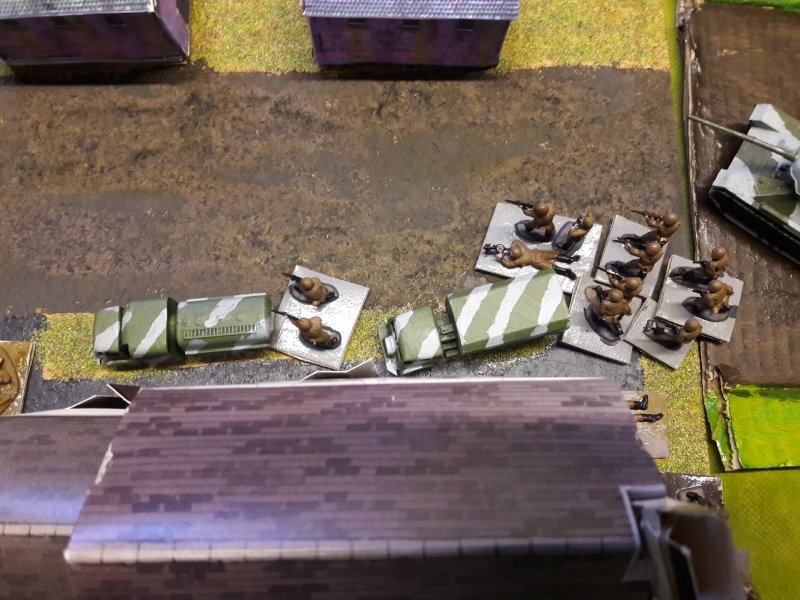
Transports start to unload

Soft vehicles park and unload men
West Friesland forces advance steadily
As the West Friesland column moved up, confident as no East Friesland weapons had yet been able to penetrate the armour even on the PZI other than the threat of artillery fire, rifles cracked from the roof of a building as snipers tried to strike at the advancing infantry. A moment later, the first shell from a 2pdr battery in the town struck close to the advancing vehicles. Undaunted, the West Frieslanders pushed on.
West Friesland Column reaches the outskirts of town
First casualties were taken by the advancing West Friesland column as sniper fire from the roofs of the buildings on the edge of town hit troops as they emerged from the trees.  A few moments later, the PZ1 machine guns rattled as it moved out into the street and the radio officer called down artillery fire on the sniper positions and now it was East Friesland men that fell.
West Friesland Recon. head back to forward airfield.

Meanwhile, the Hessnovinian force had moved into several buildings and was moving into position to strike.  West Friesland aircraft in the form of a squadron of Fokker biplanes whirred overhead, carrying out vital reconnaisance. Having spotted the T34 tanks and movement of troops from soft vehicles, the aircraft turned swiftly and headed for the advance airfield where they could deliver their reports to the West Friesland command.
Hessnovinian forces advance to edge of Braaga
A general advance order had been issued by the West Friesland commander, Lt Colonel Kruger resulting in a push forward by the two units with armoured cover and the forward observer unit which now moved towards the woods on the left flank, hoping to get a good look at the East Friesland battle lines.
West Friesland units respond to general advance order.
Fwd Observer unit moves towards woods on edge of town.

Colonel Uri Czherjenko, the comander of the Hessnovinian forces and, nominally, what remained of East Friesland men, had taken up a room in the smithy and garage from which he could direct the defence of Braaga.
Base of Hessnovinian Ops. Artillery unit stands by.
Despite receiving intelligence from the aerial recon, Kruger was unable to use the information to change the course of a battle he had now committed forces to. With the 1st Platoon, Hawk Company advanced to the town's edge, he could not bring long range artillery to bear on the Hessnovinian armour.  The PZ1 having made a dash forward, now recoiled as a T34 loomed into view and fired a shell that missed closely. As the Hawk Company moved in to attack Hessnovinian and East Friesland positions, a second T34 moved into a defilade where artillery fire had left a crater. Unable to go forward or back without offering a target, the PZ1 and advance troops tried to push into Braaga.
Exchange of tank fire
 A moment later, the inevitable happened as the PZ1 was hit in the flank by the 7.62cm cannon of a T34 and was knocked out.  A PZIII shell bounced off the T34 which backed off into a sidestreet but the initial success of Hawk Company's platoon in attacking the East Friesland artillery position turned sour as they were overrun and took heavy casualties in a firefight with advancing elements of the Hessnovinian 24th Motorised and those within the Hessnovinian field HQ overlooking that position.

An assault by West Friesland 2nd Platoon on the white house over on the left flank was beaten off with casualties on both sides but the West Friesland troops took the heavier damage.  Meanwhile, the East Friesland armoured car moved out to rake the 3rd Hawk Company Platoon with fire which was also backed by more sniper and now machine pistol rounds from buildings on the edge of the town.

The 24th Motorised were now in complete control on their right flank having defeated the West Friesland assault. The white house was re-enforced and the ruins behind it, to further consolidate the hold.
On the edge of the wood, West Friesland forces fell back in the face of resistance and superior armour facing them.  The mortars dropped a few shells on positions believed to be held by the Hessnovinians but it was becoming clear that Braaga was too well held to fall as previous settlements had.  The West Friesland forces needed to regroup and consider the impact of finally facing armour and troops that could not be easily overrun.
To add to West Friesland woes, the PZIV that had been heading the advance on the West Friesland left flank was hit by a T34 and brewed up as the shell penetrated the front armour. No East Friesland weapons had been able to damage a PZ armour unit since the action began. Suddenly, the boot was on the other foot.

That signalled the end.  Kruger, seeing he had lost over half of his armour and the best part of two platoons, withdrew his forces leaving Czherjenko in control of Braaga. It was the first engagement featuring these two leaders in a new phase of the war.

Monday, 13 March 2017

East Friesland - Battle for Braaga

After the fall of Kovoska, the East Friesland forces were driven back swiftly by the Barovian backed West Friesland army.  Only when assistance arrived from The People's Republic of Hessnovinia began to reach the front line, were the East Frieslanders able to start putting up resistance.

This battle takes place nearly 3 months into the war. A single platoon of East Friesland troops hold the outskirts of Braaga against the onrush of the West Friesland advance.
 
A small platoon take positions along the western edge of Braaga
Outdated East Friesland guns await the order to fire.
 A full company of West Friesland men have arrived in the form of four platoons and a command unit backed up by Barovian armour and guns. They have complete air superiority, allowing the West Friesland bi-planes to fly freely, dropping small bombs, carrying out reconnaisance and strafing targets.
West Friesland platoon with PZIII
West Friesland platoon with old PZIV

Unbeknown to either force, a Hessnovinian company is about to push into Braaga to support their East Friesland allies with armour and vehicles. This element of the 24th Motorised Brigade is just one of the new entrants into the war that are about to change the one sided nature of the conflict.
Hessnovinian C Platoon with half tracks and scout car

Watching his troops advance, Lt Colonel Marc Kruger, in command of the West Friesland forces, signals the light artillery to prepare to fire on targets provided by the forward observers.
West Friesland Command Unit wait on a wooded hill

PAK artillery waiting for fire orders
The West Friesland 1st Platoon of Hawk Company of the 11th Battalion advance along a narrow track while elements of the 2nd Platoon, gunnery and observation close in on a deserted warehouse.
1st platoon  Hawk Company- West Friesland 11th Battalion

Forward Observation Team advance position.
On the eastern edge of the field, the Hessnovinian commander, Colonel Uri Czherjenko commandeers a building with attached garages and orders A and B platoon to move up.
Hessnovinian A Platoon unload in front of command building
B platoon with T34s move up also.
(The picture above shows the platoons gathering. The figures on the right are the command group - where figures placed against a building, they will be considered inside.)

West Friesland had complete air superiority at this stage of the conflict.
Thus the stage was set for the first clash involving Hessnovinian troops directly and one that would lead to a further escalation as Barovian units would respond in kind within a month of this.  On the East Friesland side, then, one platoon of EF light infantry with soft transport, 3 platoons plus command unit, Hessnovinian 24th Motorised Brigade plus 2 half tracks, one armoured patrol car, 2 x T34 main battle tanks and 2 soft vehicles.   On the West Friesland side, 3 standard platoons and 1 artillery platoon with PAK88 gun, 1 command unit with soft transport and command vehicle, 1x PZ1, 1xPZIII, 1xPZIV, 1 half-track, 3 x Fokker Bi-Planes with 2 AP bombs and machine guns. 

The objective - control of Braaga.  This battle represents one small slice of the greater conflict for the town and, as normal in such campaigns as this, the outcome will decide the overall result of this phase of the struggle for the town.  To be continued.....

Monday, 16 January 2017

The Old School House Siege

So.....what a long break from the blog and the wargames table. Life isn't quite as simple as it used to be and priority had to be given elsewhere for a while but here I am, back again to indulge my interests in public;

The Old School House Siege is the second part of a skirmish between invading West Friesland military, a facist power with extensive military capabilties and communist East Friesland.  West Friesland had been bringing troops in on cargo ships for weeks when they launched this assault.  Beset by better armed men, the East Friesland military police battle to retain control of their parliament house.  Meanwhile, ministers slip across the rear lawn to safety.

West Friesland troops push forward


By this stage, the East Friesland MP had lost most of the vantage points. A mortar was shelling them from the hill and reports were coming in that more West Friesland troops had arrived on the outskirts and were now advancing into the railway yards and factory areas of the city.

As the East Friesland force gathered about the Old School House, trying to make best use of sandbags and defensive points, one of the APCs took a serious hit from the PZ1 causing it to catch fire. Moments later, it had brewed up and stood useless, aflame in front of the building.

The mopping up began shortly after. West Friesland troops took up positions all around, including on advantageous roofs and balconies. A last hard core of the communist MPs fought bravely on until the last, making West Friesland pay for the ground but the Parliament building had fallen and a bitter blow had been struck by the old enemy.

Meanwhile, the loss of the majority of the East Friesland fleet had enabled the invasion to move on at a pace backed by the Facist Alliance.  However, the Peoples Republic of Hessnovinia had gathered a fleet task force including a number of troop ships ready to come to the aid of their much smaller ally.


Wednesday, 27 July 2016

Meanwhile...in the Gulf of Caranthia

Where was I?  It's been a hectic month. So hectic, I managed to miss my appointments for progress and chemo because I had it so fixed in my head (and on the calendar) that they were this week.  There has been bowling on most days and as Club Captain, that means a lot of work as well as play plus a wedding reception there which wanted planning out, the usual coaching, a 99th birthday and life..... all of which tends to trump wargaming and its preparation.

Anyway, let's get the story of this alternate/fantasy earth-like planet and its wars back on track. There was a facist attempt in progress to overthrow the communist government of East Friesland and unite the two island states into one.

While the struggle went on for control of the capital, Kavoska, a West Friesland naval force was inbound for the port of Hajukja, intent on landing facist re-enforcements.  Barring their way in the Gulf of Caranthia, the East Friesland navy, such that it was.  That force now sailed southwards to intercept.

The two forces were largely destroyers and, in the East Friesland case, torpedo boats. Although West Friesland had a battleship, it was an old, out of date ship that could not keep up with the fleet. The cruisers and light cruisers were the key capital ships. After that, it was down to the lighter units to use torpedoes to cause damage.

West Friesland swiftly turned eastwards, aiming to use the channel north of Hornsbergen to make their approach. Forming into a core flotilla, the cruisers sat in behind a screen of destroyers.
At this stage the wind was blowing against the West Friesland fleet (from the east) but not strongly. The West Friesland command, sighting the enemy through the slight haze, decided to throw out a screen of smoke to cover a rapid move ahead by the cruisers.
Meanwhile, the East Friesland ships had split into small sub forces intending to try and catch the enemy on the hop with its torpedo boats.  The issue was to be proven that old torpedo boats were too slow to keep up so by the time they arrived in position, the battle was largely decided.


The first blow to East Friesland was their advancing light cruiser Scheilander moved in to fire on the lead WF destroyer, Patozec but the destroyer swiftly turned across her bows and let go with a full spread of torpedoes which the marker above shows put four of five in with a chance of striking.

The effect was devastating and shortly after, the cruiser listing badly as she tried to escape, sunk as more torpedoes slammed into her. The West Friesland flotilla pressed forward and soon, the second EF light cruiser was ablaze.  One by one, the EF ships were sent to the bottom or forced to pull off and run, damaged badly by WF fire and torpedoes. One of her light cruisers, Jacolek succeeded in destroying one WG ship and damaging another but took so much damage in reply that she had to steam south-east, running for Parvik with what remained of the fleet.
The cruiser can be seen heading south and torpedo boats still stretching to reach the battle. Heroically, the EF Minesweeper "Dornica" blocked off pursuig ships, striking with her light gunnery before running aground on a sandbank after her bottom and hull were torn apart by torpedo fire.

The battle was done and West Friesland troop ships soon broached the channel accompanied by the old battleship, "Kempvert" which would offer a floating artillery platform to support the landing.

The East Friesland torpedo boats use the islet as a cover before pulling out as West Friesland ships take position  to bring the troop ships through.

The battle was decided not by the longer range guns, which largely proved ineffective, doing little damage before the ships closed to torpedo range where the West Friesland destroyers with multiple tubes did a lot of damage at close range to light cruisers, destroyers and torpedo boats alike. The torpedo boats by comparison with less tubes and a need to fire forward to cause most damage were no match.  East Friesland's fleet was outnumbered and outgunned. It proved that intent was not enough at sea.

The result of this encounter was twofold.  First, West Friesland were able to make a landing and set down re-enforcements to continue the invasion of East Friesland.  Secondly, East Friesland's ally, the People's Republic of Hessnovinia ordered the Vostagrad fleet to sail south, protecting troop and supply ships carrying equipment and troops bound for East Friesland. One of the world's major powers was about to intervene directly to prevent its communist ally from falling.  With a Barovian fleet approaching and also a North Maravaal flotill heading into the area, the clash of beliefs was about to widen the conflict way beyond and old rivalry.

It was as the military analysts had been predicting.

Wednesday, 22 June 2016

Busy with preparation

I don't know if you guys out there find the same as I do but I tend to pause between wargames, especially if they are part of  a campaign, while I find and paint new pieces.

Recently, I acquired a large number of AFVs and support vehicle, mostly on eBay.  For me, that's the start point.  I like to convert all that are chipped and worn to the colours and emblems of my mythic nations.  As each nation has one or several large boxes in the "command centre", they then transfer to their appropriate nation.

I  have also been working on a new world map for a simpler "world war" that will be conducted on a manageable scale.  It fits neatly onto 8 x A4 sheets and is supposed to be largely ocean so another 4 x A4 would be added top and bottom with nothing of consequence to make a full map.  Anyway, the beauty of this world is that it has a limited number of nations with an even more limited number of participants.

Anyway, on to the point of this note.  The Semille scenario between Doza and Pays De Cheval was not worth playing out as the surviving units from the PDC would have been completely overwhelmed by the Dozans.  I put that down as a map victory given the battalions moving in and those standing.

Which means I get to start my next planned scenario set.
This one doubles up as both East Friesland and simultaneously, East Hamvoord, which it was originally intended for. East Friesland is one of a pair of very close islands which have a long history of conflict and unification. After the last war, East Friesland's extreme right wing government was ejected and replaced by a communist one, The Republic of Hess Novinia having freed them from the facist invasion.  West Friesland was freed by Celtica Maritime, Maravaal and Chelician troops and allowed to drift back to a right wing democratic government.

East Friesland was comfortable enough. They had been alternately communist and socialist prior to the war.  Their relationship with West Friesland continued to worsen over the years with frequent posturing and friction between them, including frequent military manouvres close to one another's borders.

During the past five years, with an international restriction on arms sales, East Friesland has not moved on in technology terms.  However, West Friesland has secretly been allowed access to designs for armour and hand weapons by Barovia.  Furthermore, Barovia has recently shipped a number of obsolete fighter aircraft to the island state under the guise of machinery.
With Barovia offering some help and backing, West Friesland makes its move. Late Spring 1942, troops land in secret and make their way to the capital, Kavoska (Kav-oss-ka) in small groups.


The centre of East Friesland government (and united Friesland in the past) is The Old School House in West Kavoska. Here  is where democracy begun and to this day, it forms the core of the parliamentary buildings. Across the square, stands St Constance's Church on the steps of which, famed democratic campaigner, Milos Gaaven was shot, leading to the Freedom Riots of 1802.


 Whereas East Kavoska is industrialised, the West side of the city gives way to rural housing and then countryside.  Thus the appearance of an angry mob outside the Old School House during a debate on tax and financial plans is unexpected.  When stones and a couple of Vandegrad Cocktails are thrown, the call goes out from the security at the building. 

An angry mob starts to build
Shortly after, the military police arrive but the mob disperses swiftly, just melting into the night. As the military start to secure the area and post more guards, the trap is sprung.

Military Police arrive but the mob is in no mood to fight
West Friesland soldiers appear and open fire on the East Friesland Military Police.  Immediately both outgunned and surprised, the MP unit retreats and sends out a frantic telephone call for further backup. Unfortunately, at this stage, they fail to mention the suspicion that the enemy are trained military and well equipped.


A further unit of military police turn up with a couple of armoured cars, expecting that will be more than sufficient. It is just the beginning.
Help arrives in the form of FAI APCs
More enemy troops are moving in and they have also brought some backup.

Trapped in and around the Old School House, the military police begin a stubborn resistance to the attack coming in from several sides.  More petrol bombs are thrown. The politicians are led out of the rear and through the old gardens to safety as the military set about putting up a fight.
The old gardens offer a haven behind the Parliament buildings


The protagonists:
East Friesland Military Police and FAI APCs

West Friesland Troops with Half Track and PZ1
Two platoons of each MPs and WF troops balance the game somewhat although the WF also bring an HQ unit attached to which is a PZ1 tank and a half track.  The PZ obviously has th advantage since it can pierce the FAI armour with ease whereas the 7.62mm machine gun used by the East Friesland is not going to cut through its armour.

Next article - "The Old School House Siege"