Wednesday, 22 June 2016

Busy with preparation

I don't know if you guys out there find the same as I do but I tend to pause between wargames, especially if they are part of  a campaign, while I find and paint new pieces.

Recently, I acquired a large number of AFVs and support vehicle, mostly on eBay.  For me, that's the start point.  I like to convert all that are chipped and worn to the colours and emblems of my mythic nations.  As each nation has one or several large boxes in the "command centre", they then transfer to their appropriate nation.

I  have also been working on a new world map for a simpler "world war" that will be conducted on a manageable scale.  It fits neatly onto 8 x A4 sheets and is supposed to be largely ocean so another 4 x A4 would be added top and bottom with nothing of consequence to make a full map.  Anyway, the beauty of this world is that it has a limited number of nations with an even more limited number of participants.

Anyway, on to the point of this note.  The Semille scenario between Doza and Pays De Cheval was not worth playing out as the surviving units from the PDC would have been completely overwhelmed by the Dozans.  I put that down as a map victory given the battalions moving in and those standing.

Which means I get to start my next planned scenario set.
This one doubles up as both East Friesland and simultaneously, East Hamvoord, which it was originally intended for. East Friesland is one of a pair of very close islands which have a long history of conflict and unification. After the last war, East Friesland's extreme right wing government was ejected and replaced by a communist one, The Republic of Hess Novinia having freed them from the facist invasion.  West Friesland was freed by Celtica Maritime, Maravaal and Chelician troops and allowed to drift back to a right wing democratic government.

East Friesland was comfortable enough. They had been alternately communist and socialist prior to the war.  Their relationship with West Friesland continued to worsen over the years with frequent posturing and friction between them, including frequent military manouvres close to one another's borders.

During the past five years, with an international restriction on arms sales, East Friesland has not moved on in technology terms.  However, West Friesland has secretly been allowed access to designs for armour and hand weapons by Barovia.  Furthermore, Barovia has recently shipped a number of obsolete fighter aircraft to the island state under the guise of machinery.
With Barovia offering some help and backing, West Friesland makes its move. Late Spring 1942, troops land in secret and make their way to the capital, Kavoska (Kav-oss-ka) in small groups.


The centre of East Friesland government (and united Friesland in the past) is The Old School House in West Kavoska. Here  is where democracy begun and to this day, it forms the core of the parliamentary buildings. Across the square, stands St Constance's Church on the steps of which, famed democratic campaigner, Milos Gaaven was shot, leading to the Freedom Riots of 1802.


 Whereas East Kavoska is industrialised, the West side of the city gives way to rural housing and then countryside.  Thus the appearance of an angry mob outside the Old School House during a debate on tax and financial plans is unexpected.  When stones and a couple of Vandegrad Cocktails are thrown, the call goes out from the security at the building. 

An angry mob starts to build
Shortly after, the military police arrive but the mob disperses swiftly, just melting into the night. As the military start to secure the area and post more guards, the trap is sprung.

Military Police arrive but the mob is in no mood to fight
West Friesland soldiers appear and open fire on the East Friesland Military Police.  Immediately both outgunned and surprised, the MP unit retreats and sends out a frantic telephone call for further backup. Unfortunately, at this stage, they fail to mention the suspicion that the enemy are trained military and well equipped.


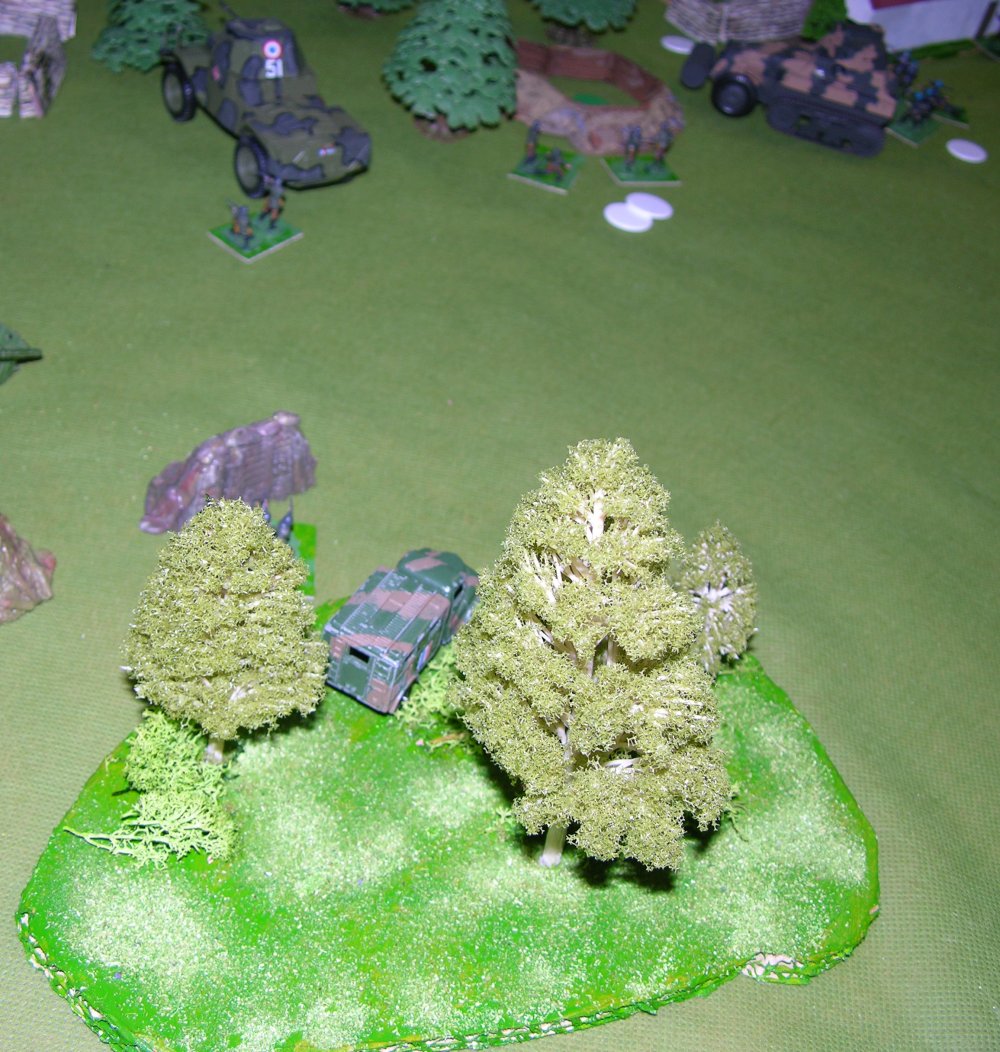
A further unit of military police turn up with a couple of armoured cars, expecting that will be more than sufficient. It is just the beginning.
Help arrives in the form of FAI APCs
More enemy troops are moving in and they have also brought some backup.

Trapped in and around the Old School House, the military police begin a stubborn resistance to the attack coming in from several sides.  More petrol bombs are thrown. The politicians are led out of the rear and through the old gardens to safety as the military set about putting up a fight.
The old gardens offer a haven behind the Parliament buildings


The protagonists:
East Friesland Military Police and FAI APCs

West Friesland Troops with Half Track and PZ1
Two platoons of each MPs and WF troops balance the game somewhat although the WF also bring an HQ unit attached to which is a PZ1 tank and a half track.  The PZ obviously has th advantage since it can pierce the FAI armour with ease whereas the 7.62mm machine gun used by the East Friesland is not going to cut through its armour.

Next article - "The Old School House Siege"

Wednesday, 8 June 2016

A break from modern warfare

I have been promising myself that when I had the table clear, for a bit, I would take the opportunity to have an ancients clash.  And so to a period in the alternate earth history when the Greek-like islands of Thacia were busy fighting one another for control of trade more than any other factor.

The section of my world map below illustrates the general area of the conflicts that were rife at about 500AC (After creation - according to the ancient calendar of the Cyrenician and Thacian recorders).
The year is 512AC. The Lyceans have swept over near neighbours, Leona at the battle of Vanas (more of a skirmish where a very outnumbered Leonan force was swept away by chariots and light horse). Landing on the larger island of Antrasa. There, they are met half way by the Admatians, considered by most to be the leading Thacian city-state. Admatia does not wish to fight on its own ground.  Additionally, victory might place Antrasa within their grasp.

Anchotes, lead figure on the Council of Alma has persuaded the Admatians to vote enough money to take an army into Antrasa to face the Lyceans.  His rival Persilus conveniently arrives late and chooses to stay behind so he may throw his support behind Anchotes or criticise him depending on results.

The Lycean leader is a youthful king, Barises. Flushed with success from Leona, he comes at the Admatians outside Phelos with little thought of anything but another victory. His forces are 2 scythed heavy chariot units (Royal Chariots), 2 light horse units (Fort Hallas and Covilan 1st), Troilan Spears, Leonan Spears, Lycean 1st Spears, Lycean 2nd Auxiliaries, Lycenan Household Auxiliary, Fort Hallas Archers and 2 light Psiloi units, Leonan Plainsmen and Eronean Light Foot.

Anchotes has a more regular force, Oronean 1st, 2nd and 3rd Spears, Admatian 1st and 2nd Spears, 1st and 2nd Alman City Guard (Spears), Minastran 1st Spears, Chalander Spears, Anchotes Own Household Cavalry, The Bravios Auxliary and Alman Light Foot.

The following was the Battle of Phelos between Lyceans and Admatians played under DBA rules;

Move #1  Mostly posturing as the sides advance, slowly.
The sides square up.
 However, Anchotes briefs his lieutenant, Codis to take the household cavalry on a jaunt which heads for the only bridge across the swift flowing but narrow river.  If they can cross back, they will be able to come around behind the Lyceans and cause potential chaos.

Move #2  Lyceans Advance - two units seize control of Langos Hill on the right.
Fort Hallas Lt Horse & Archers move onto the hill

The rest continue to crawl forward
              
Meanwhile, the Admatian cavalry are crossing the old bridge
.
   Move 3-4 The sides make a slow advance.  The Fort Hellas archers make no impression as the massed spears simply adopt a defensize tortoise and the arrows rattle off shields.

"So who was the first to die?" writes the poet and lyricist, Solopher; "was it one of the sturdy men of the Alman Guard or a javelin bearer from the blue Valor lapped shores of Soris below Lycena?  No, it was a youthful spearman, Agdus whose father kept the hounds for his lord in the manse of Senthe, below Seneca where the rolling lawns went down from the cypress plantations to the golden sands of the Admetia's shores. He raised his shield high to protect the heads of his fellows but too high, he held it and a javelin from a passing Hellas rider struck him and pierced him sorely so he fell and the darkness came upon him. But he was loved by the Gods and Athelene was sent to snatch his soul and take it to the halls of the warriors where he would sit with pride for his father was Daragus who had fought beside the legendary Prestus at Erinthe and who had struck down the beast that ravaged Norica. Such was his bloodline."

The Fort Hellas light horse gallop by, sending javelins into the ranks but like the archers, could make no impression.

The isue for the Lyceans, now was that the Admatian 1st and 2nd Alman Guard Spears marched forward forcing the Hellas archers to recoil as the Hellas Light Horse headed back to the ranks.
Sending in his chariots with Psiloi to support, Barises hoped to strike a blow against the enemy flank and go on to win as he had against the Leonans.

However, the Admatian spearmen were made of sterner stuff.
Admatian 2nd spear and Alman 1st City Guard hold the chariots and turn them aside, destroying both units quite swiftly.

The Lyceans wheel spears in to try to halt the now inevitable Admatian advance.


And now the sides lock horns again but the Oronean Spears are making headway through the centre and must be stopped. Young king Barises has nothing to use but light horse and psiloi
Outmatched, the Lyceans gamble
The end is inevitable.  The Psiloi with their general behind stand against the spearmen but the light horse, both Fort Hellas and Covilan 1st retreat at full pace from the table.  As the archers start yelling about the Alman household cavalry which are closing from the left flank, Barises signals a full retreat.
Where did they come from?

All up for Lycea

The game was effectively over in seven.   It's been a long time since I played DBA. I had forgotten some aspects of it.  I will hold my comments until I have given it another go with, perhaps an updated set of rules but playing today reminded me what I liked about systems with more detail and allowance for the types of units in charge and other modes.

So, now I need to put Admatia (Athens) against Antrasa (Sparta). The chariot and horse based Lyceans proved inadequate.  Perhaps one unit of LH should have been knights. Anyway, another day.  It was nice to play something different and with a little scenery and more representation.  I always feel ancients allow for symbolism and set ups that have purpose rather than necessarily being realistic.

I am about half way through a Persian army which will be Cyrenicia in this world. Also a lot more Greeks to allow me to play out more city state battles :)  Always fun. And so, the last word from our story teller, Solopher;

"And at last as hot tempered Helidorus let his chariot sink into the sea, Barises came to his tents and there was ministered for his wounds and his grief.  The flower of Lycea lay trampled upon the sandy earth below Phelos.  There Galluses whose mother was Della beloved of the River God, Xaponus, Galluses of the flashing eyes and ringing voice.  Numos of Raye struck him down with a spear thrust which entered his bowels and Galluses fell like a bullock when the spear is driven down into its neck. So also ended Eridosian, son of Ericos who rode the great shark, Strak and who rescued the maiden of Lagonis, Eyasa to be his wife. The spear that struck down Eridosian was wielded by a cousin of Anchotes, Anchulisis he of the white skin and great height. He was a captain of his troop and well they were led, this day.

The sands were soaked with their blood. A great pyre was built and set afire that evening in the honour of the fallen and many a spear stack was placed about it. So ended Lycea's attempt to rule the islands and chastened, did their king return home."
                                                                                                                    

Saturday, 21 May 2016

Assault on Aucherre PT2

Despite a strong defensive setup, the PDC was again proving unable to hold the better equipped and co-ordinated forces of the Dozans.  Better secondary firing and assault might have cost the Dozan advance all its half tracks but after being suppressed, they were allowed to pull away, again. The Schneider with its powerful 37mm gun and 7.62 MMG with full cover, button-down top has proved more like a tank than personnel carrier.  Indeed, it was designated as an armoured car by the Dozans when built.
Moment of concern for B Platoon
Above was a typical moment in the series of battles fought between PDC and Doza. The Schneiders will take a light hit but unless gunnery is accurate enough to finish the job, they are soon off again, causing damage. A soft half track would have been lost much more easily.

Undeterred by the inadequate defences, the Dozan assault began in earnest.  The orchard soon fell to the advance although not without more losses on both sides.
Firstly an assault through a side gate
Then the full out attack down farm lane

Despite resistance that laid low a couple of the attacks on the farm, the push up farm lane proved too much and after a last round of firing from the PDC LMG units in and around the inner yard, the farmhouse was overrun.
Meanwhile, frustrated by the machine gun tower in the orchard, multiple air attacks were launched, culminating in the destruction of that installation, allowing A platoon and HQ units to advance through the now quiet orchard.
Dewoitines take light damage and pull out

Medium bomber finishes the job

 And moments later, radio from artillery HQ instructed PDC 3 Platoon and their guns to pack up as the HQ hitched up and headed out.  Behind them, the Dozans had begun a mop up.
Another victory for the Dozans.  With the fall of Aucherre, the road to Semillon lay open. Unless the PDC and allies could now hold the industrial town, then the capital, Verdoune would be left open and the Pays De Cheval must surrender their country up as fallen.  Analysts predicted it would be over within a couple of weeks. The PDC and East India Federation had shown nothing that would stop the Dozan advance.

Friday, 20 May 2016

Dozan Invasion of Pays De Cheval, Scenario #3 Assault on Aucherre

The decision tree has not proved in the least complex, so far. With Dozan victories at Semille and Le Meux, only a clear EIA/PDC victory could delay matters by bringing in forces at Falcieu. Anything less would now trigger Advance on Semille and the end of the second phase of this invasion.  Pantinole had now been seized by Dozan forces and was set up as forward Battalion HQ.
The key to Aucherre was a large farm complex just outside the town and overlooking the road from the south (and west). This has been used as the HQ of the PDC 4th Battalion since the initial retreat from the border.

Now considerably re-enforced, it controls the road from Aucherre to Semille. A minefield lies south of the complex then an orchard in which now stand machine gun positions. A Dozan reconnaisance mission had moved up just after dawn three days earlier, intending to probe and report back but it was so badly shot up, the report from the few who escaped convinced the Dozan command to halt the advance on the farm immediately.

Concerned that they might lose more armour and supporting vehicles than was justified, the Dozans held back forces and settled to building a temporary airfield a few miles south-east of the target.  Lieutenant-Colonel Jules Le Savage, normally in command of the Dozan 6th Battalion "Les Aigles Noir" had passed overall command of this scenario to Brigadier-General Francois Margot-Jauvin.  The criticality of this strategic position had resulted in the deputy commander for the whole PDC theatre to have been put in charge of this assault. Margot-Jauvin was one of the architects of the new Dozan military.

Standing on high ground some three miles behind the active line, the general turned to Le Savage; "I am glad your men have this task.  I'm confident they can do what must be done.  As we agree orders, you can relay them down the line.  Who've you got down there?"
Le Savage took a deep draw on his cigarette and walked a few paces;
"Major Charles Colm and Captains Nicholas De Chevney and Ralph Thibault. All sound men. Colm is careful but thorough. De Chevney's your man for taking risks.  Their companies have all performed notably, to date. This target is much tougher. I do have concerns that withholding the armour is being over protective."
"The enemy cannot know how little we really have at our disposal. It must look like we are always able to produce fighting vehicles when needed. A frontal assault by our armour could result in unacceptable losses and blunt the whole initiative."
Margot-Jauvin chewed his moustache, slightly and fiddled with his cap; "In a few weeks, we will get more supplies coming through. Until then, we must fight with what we have at our disposal. I have sent for whatever can be spared from the remaining pool."

"Then perhaps we should switch to a night attack," suggested Le Savage. "Considered it, but decided against. Our air superiority is what will win us this battle."

In the farmhouse within the Aucherre complex, Colonel Maurice Tateau finished his breakfast of eggs and brioche. Wiping his mouth with his serviette, he waved a hand vaguely; "This time, the Dozans will not break through so easily.  They lost a scout vehicle in the minefield as well as the squad they sent in as reconnaisance from the lane."

"we should not underrate them," replied Lieutant Paul Messigne, "they have won every encounter of any scale, so far. We must be watchful and defend with fervour."

At that moment, the drone of aircraft was heard approaching. "Now we shall see what they make of our flak and machine gun tower.  Not so easy when you have  someone firing back, eh?" Tateau raised his voice over the sound of the aircraft. They looked up. A whole flight of Dewoitines screamed down towards the farm.  In reply to their machine guns, the flak battery opened up and machine gun fire from various spots threaded up to meet the incoming aircraft.
There was a loud report and thick oil and smoke started to stream from the engine of one of the dewoitines,
"You see, victory to us, this time. That plane is doomed. Ha, see if you like it when we hand it out for a change." shouted the Colonel.
Then he and the others were flung to the ground as the bombs from the dewoitines hit home. There was a massive flash and a pillar of fire as the first missed the flak but flew over the hedge and hit a fuel bowser. The second was on target and another explosion was followed by whining and clattering as shells in the storage cases were hit and fired in all directions. The flak battery was lifted into the air and spilled backwards off its mounting as the explosion ripped through it. Another bomb hit home in the same yard sending more tangled parts and bricks skywards.

 First air attack hits home

The Dewoitines had taken out a truck with mounted lmg, damaged a pillbox, destroyed the flak battery and a fuel bowser into the bargain. Note one aircraft trails smoke as it heads downwads to crash a couple of kilometres further on, in a field.

This was followed by Dozan planned artillery firing.  Possessing two batteries of 155mm guns (off table), the Dozans forward observers had already set initial planned ranges. Shells now fell in the road at the head of the farm lane and on the edge of the orchard near a currently abandoned gunnery position.

As PDC and Nordovician troops ducked for cover, (C)astellan Platoon moved in on the farm with the Schneider Half Track carrying half the platoon and the others using it as cover. The howitzer watching the lane fired and hit, a glancing blow only with the shell exploding clear of the vehicle but enough to shock the crew who were suppressed and screeched to a halt while the gunner looked to see where the shot came from.  As the men poured out and around from the halted vehicle, the damaged pillbox opened up on them but a volley of grenades and a shot from the Schneider finished that one off, leaving smoke pouring from the fortification.
The initial assault meets stiff resistance

The second pillbox was also firing, now, C platoon taking 2 bases from MMG fire inflicted.

(B)aille Platoon now followed that lead, their half track advancing on the farm with those not inside charging at double pace towards the walls of the farm which would provide some cover. The half track was struck a glancing blow by the 2pdr in the farmyard dropping a shell very close. Teams unloaded and the Schneider returned fire but caused no casualties.

At this point, the PDC command were still quite confident that despite losing the flak, their defences were holding well. It looked like the cost of the assault would be too high for the Dozans to sustain it. If the guns could follow up and knock out two half tracks, the tide of the battle would certainly turn in the PDC direction.
Two half tracks are hit as they move in but another air attack heads in
The Dozans then released their second air assault, led by an Liore et Olivier medium bomber escorted by a Morane Saulnier.  That put paid to the howitzer behind the corn field. Another hit on the fuel store caused another explosion and a thick pall of smoke began to drift downwind (south) across the farm.
Smoke from multiple targets drifts as the attack continues

A(erial) platoon had begun to advance on the Orchard, meanwhile, supported by a 
Panhard APC. Behind them, the command HQ unit moved onto a ridge to watch the outcome of this clash.
The chattering of the machine gun tower sent men running as shells rebounded off the Panhard which fired but failed to damage the tower at all.
Dozan HQ unit moves to a vantage point
PDC 3 platoon then opened fire from their position in the field as the Dozan D Platoon (borrowed from seperate Battalion) advanced to use the wall as cover. D platoon then assaulted the pillbox but lost a base of casualties.
Dozan D Platoon take casualties on right wing

In the orchard, the PDC artillery tried to slow the advance with their battery behind the farmhouse but to no effect. Fighting was getting heavier there and now PDC HQ elements moved across the river with a thought to outflank the advancing Dozan left.
As smoke continued to drift south, the farm was under pressure
Despite efforts from the PDC platoon in and around the lane, the Dozan advance continued and now men were swarming about the rear gates of the farmhouse. The 2pdr was knocked out and as smoke drifted south over the farm, it was obvious that the Dozans were still making progress despite the heavy fire.  Long range artillery called in by the Dozans was helping extend that pressure and now, the call for further air strikes had been made.
 
Pt 2 of the Assault on Aucherre coming very soon :)

Monday, 16 May 2016

Background for a World War

A bit of background on the "WW2" that is unfolding on our alternate world;

The intention was to fight a series of linked battles, each representing a short stage in a much larger overall conflict.  Set in a mythic 1942, there has been a much smaller "WW1" which ended with the facist right block being forced to sue for peace and restore lands after the communists weighed in on the side of the beleagured allies.  One outcome of this was a number of small communist states where the right-wing governments were overthrown or in some cases, more moderate ones who had ended up on the wrong side.

The world that these games are set in has many elements that are similar to our own.  So, there is a fading modern Empire (Hardican) which can no longer hope to hold onto its many trading acquisitions but does have considerable strength and resources.  There is a much older empire that has been in decline for centuries (Nordovician) and is now the East Indies Trade Federation most of whose members are dominated by the Nordovician ruling class and includes the PDC (Pays De Cheval) now under attack by Doza.
PDC forces using WW1 U.S.A

The major communist power is Tobaria, which has been slapped back in the past when attempting to expand. By moving in with the allies in the war some thirty years previously, has gained some trust, trade and ground with the above two powers.  Idealogically, Tobaria stands as supporter of all communist regimes and opponent of all right wing facism. With a recent arms embargo lifted, it has sold some weapons to states it regards as potential supporters.
 Tobarian hardware on show

Those sales innclude some among the allies, particularly the Bartragian led Northern Allied Defence and Confederation (NADAC) whose members are Bartragian, Saxonia, Lander, Raga, Lazadon and Draga.  They are close allies of Hardica as are the other power on the allied side, the Memmonian and Janazian Union. (or U.S.M.J). The two key states in this alliance are similar to Australia and South Africa, an unusual but close pairing based on states grown completely by migrants, the sparse, undeveloped indigenous population largely excluded from government until very recently.

Hardica use UK troops (1/35 here)

Leading the facist block are Volcia and Montamar, both governed through the old imperial Samedes family. They also hold other land including the trade and secular political control of The Grand Duchy of Hanneberg where power is shared with the Papacy.  The right wing allies include Bank-Nar and, until the last war, Tarlinken, one of the largest overthrown governments.
Volcian armour on display

Probably backing the right wing is the Papacy which has its own forces, the Papal Legion. This varying force is hard to keep track of but certainly includes the templars who have historically retained armies and consider themselves part of the papal force. They are believed to have the most extensive espionage network of any world power.   The legion or templars or both are present in many cities of the world, supporting "good Catholic governments".

Add to this, then, two new and ambitious powers - Doza, a French-like country long harbouring aspirations and grievances with the East Indies and others, Nipoor (Japan) always feeling constrained in its back yard and beaten out of crumbling Cathay(China) by the allies twice in recent years, Nipoor has a grudge.  Lednik is a state born out of a harsh left wing oligarchy, Lednikby.  Lednikby is now a potentially stronger communist state shored up by Tobaria whuile Lednik was left free, supported by Hardica and others.  It is suspicious of its neighbours and wants to create a stable, strong state, independent in its own right.

 Nipoor troops (again 1/35 shown here)
And French 1/35 being a Dozan heavy weapons squad.


Then there are established powers such as Surmey (Turkey) who sees itself as master of North Tropicania and a major power when in truth, it has become out of date.  There is Handarus (Spain like) once part of the Grand Duchy of Hanneberg but now independent and stretching its muscles as is Esjamer, also formerly under Volcia and Hanneberg but while independent and having a friendship with Handarus and the alliance, has a strong right wing majority.  Littesburg (Swiss type alliance) once masters of war for the old empire, now independent and neutral, disturbed at the peril of those who dare. Their final intervention in the last war was the other major factor in peace being concluded.  Having a standing army of some size, they are respected.  Cathay has potential but its imperial throne cannot hold it much longer as the people threaten to overthrow the old ways and embrace communism.

Dalmania, Valdaria and Rosgovia are all former states of the old Nordovician Empire now independent. They have some views of their own as to where they might end up after another conflict.

Preparing for the various scenarios has meant taking a long review of whether I have enough of a spread of equipment, troops and scenery. It's not the same as choosing two protaganists for a short war or scenario series.  When I have a bit of a war, I like each side to have its own distinct forces. At least, most of the time.

That has led to me acquiring a lot more 1/72 troops (my choice as the general troop scale.) Boxes started appearing in the room where I work on preparing for the games.  Each box represents a national force or a part of it, in the larger cases.  For Doza, I already had some French tanks and afvs (Schneider armoured half-tracks and Panhard APC).  I had a box of Italian WW2 infantry set aside from a long time back (for want at the time of being able to access French WW2). I saw no reason to change and set about creating a battalion plus using the Italians, the specific French equipment and some general vehicles.

I had some French AFVs already

Buying French aircraft then became a commitment.  I didn't have a good selection so I decided to add to my Morane-Saulnier with some more modern dewoitine d520s, eventually buying 3 on eBay for very good prices and I was given an Olivier et Liore medium bomber as part of a birthday present, which was perfect.  (I am fortunate that some of the family and friends understand the wargaming thing.  My son and his fiancee have added considerably to my collection.)
Olivier & Liore LeO Medium Bomber with Morane escort.

That was just to get the first set of scenarios under way.  I have worked, slowly on painting all the troops involved and adding the odd piece.  The French-style farmhouse, originally a piece for Napoleonic warfare was customised, slightly and tiled for ease of use in time for the Aucherre scenario.  

For the drive to attack Semille, the final part of the scenario set, I decided it was time I had some railway evident.  I have been impressed by the way some of the guys use trains in scenarios, such as Trebian who has used them in different theatres of war with great success.
I had no railway and no rolling stock. My model railway went long ago to raise money for troops.
So, I was particularly pleased to acquire about 40 pieces or HO/OO track on eBay for a mere £3.  That has to be a bargain.  As well. I wouldn't have paid a lot for something that is going to sit unused being just scenery. But the good part, I think, is that having a good standard size, I can now buy trains and suitable rolling stock for games involving a goods yard, attacking a shipment and, eventually, maybe an armoured train with flak or a nice artillery piece fitted to a suitable low loader wagon.


As all wargamers will know - you're always on the lookout for the next piece you want ;)